

On this page, you’ll find a complete guide to the guitar neck, covering everything from profiles, radiuses, materials, construction methods, and much more.
You’ll not only discover the meaning of the multiple terms used to describe a guitar’s neck, but also how these specifications combine to influence a guitar’s playability.
Page Index
Questions? Comments? Use the comments section at the bottom of the page!
Guitar Neck Guide – Introduction

The guitar neck is where your fretting hand lives — and more than pickups, tonewood, or body shape, it’s the single biggest factor in how a guitar feels to play.
From neck profile and scale length to fretboard radius, nut width, and construction style, small differences in neck specs can dramatically change comfort, speed, string tension, and even perceived tone.
This guide breaks down every essential guitar neck specification in clear, practical terms — so you can understand how the neck of your guitar affects your playing, and ultimately, your sound.
Guitar Neck Profiles
Guitar neck profiles describe the shape of the back of the neck – the shape of the letters correspond to the physical shape of the back of the guitar neck. Neck profile can influence playing feel and technique. The most common shapes are C, D, U and V (and variations thereof).
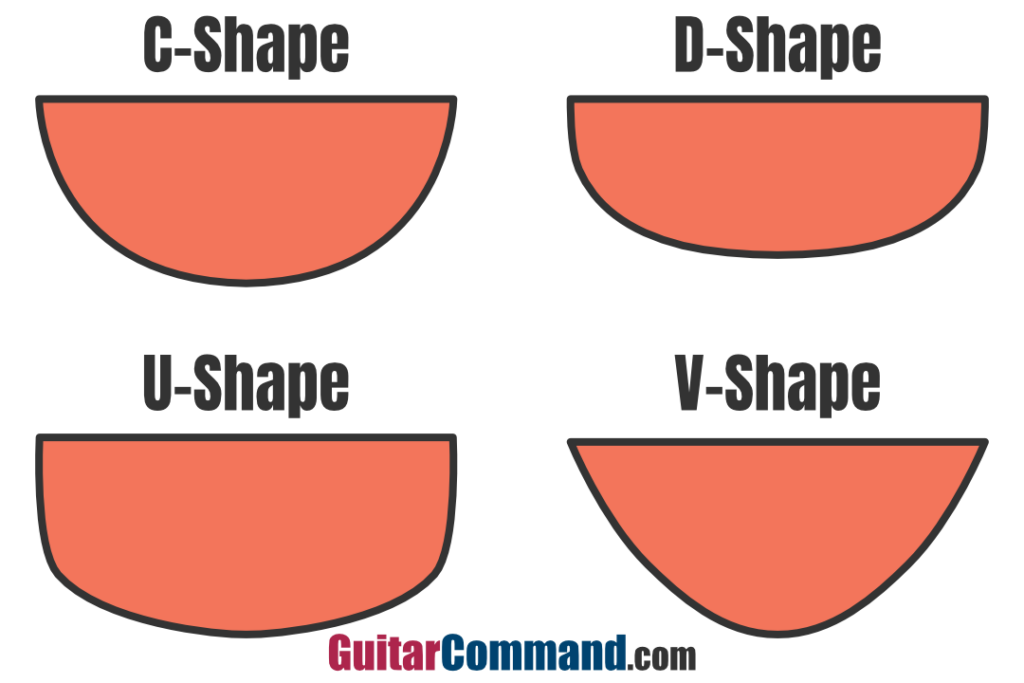
The C profile—found on many Fender models such as the Fender Stratocaster and Fender Telecaster—is rounded and balanced, making it a versatile choice for styles ranging from blues and pop to rock.
The D profile is similar but flatter across the back with broader shoulders, offering a slightly more modern feel; it appears on many contemporary instruments, including various super-Strat designs such as models from ESP and Jackson.
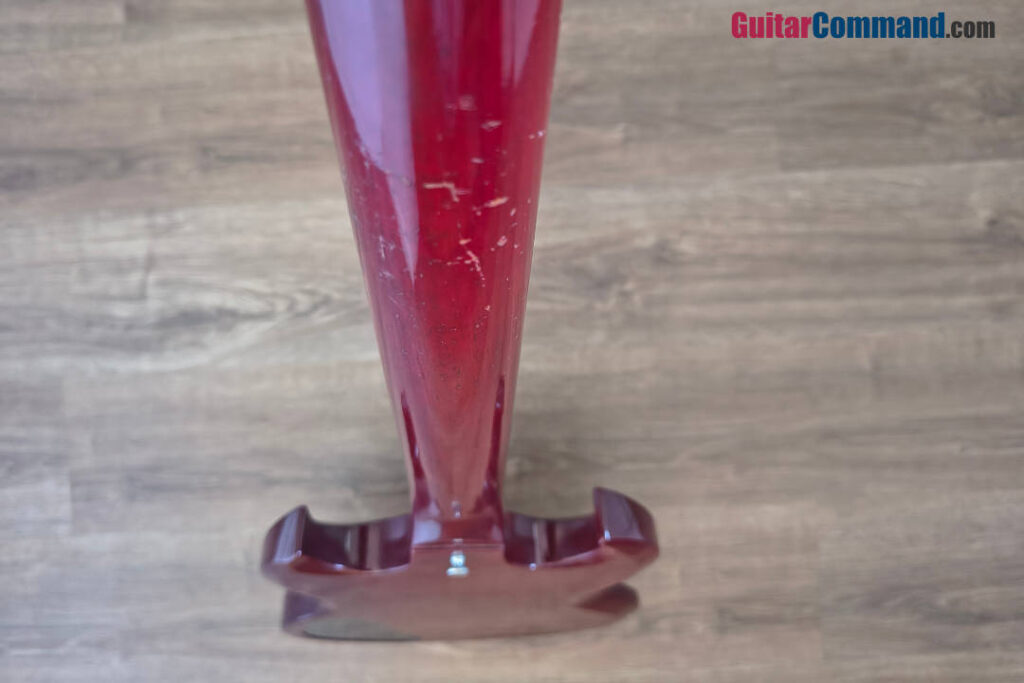
Ibanez’s Wizard profiles are based on a thin D profile. The D-profile engenders accurate, fast playing, and is often associated with shred, progressive metal, and other high-performance styles.
The U profile is a thicker profile commonly found on vintage-style Fenders and ’50s-spec Gibson guitars such as the Gibson Les Paul Standard. It provides a substantial handful of wood, favored for strong rhythm playing and classic rock tones.
V-shaped necks, seen on some vintage-inspired Strats and Eric Clapton signature models, feature a soft or hard ridge that suits blues players and thumb-over techniques.
Scale Length
Guitar neck scale length is the vibrating length of the string measured from the nut to the bridge saddle.
Neck scale length plays a significant role in a guitar’s feel, tension, and tone.
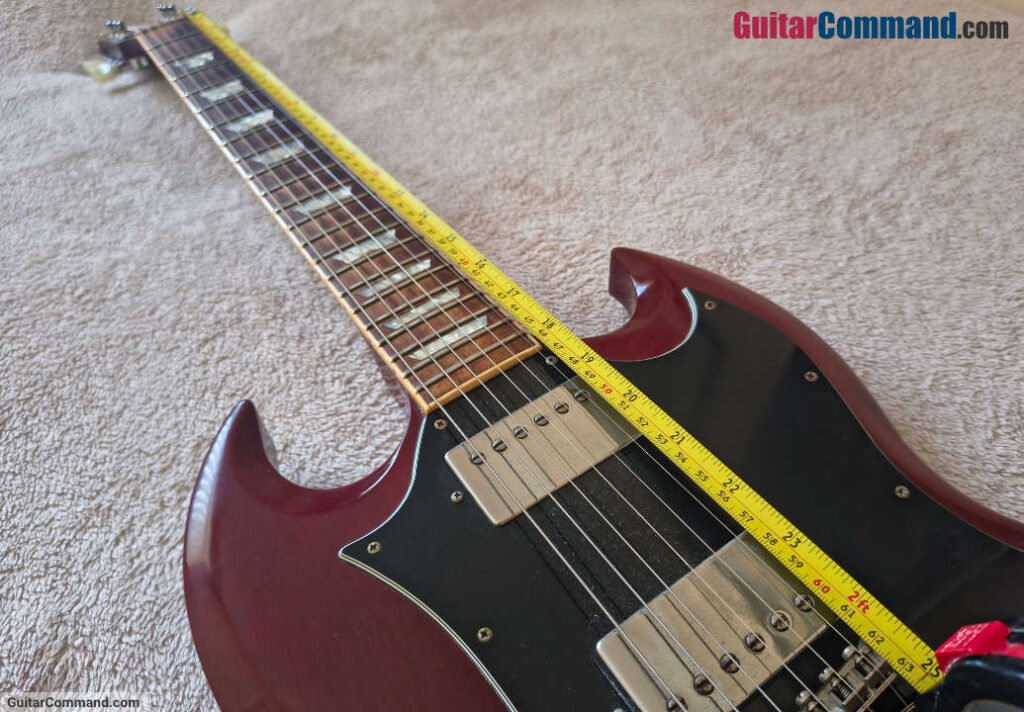
- Longer scale lengths create higher string tension at the same pitch, resulting in a tighter feel, clearer low end, and slightly brighter tone.
- Shorter scales reduce tension, making bends easier and giving a warmer, looser response.
Scale length also affects fret spacing — longer scales have slightly wider fret gaps — which can subtly influence comfort and playability depending on hand size and playing style.
The two most commonly-used guitar scale lengths are 24.75″ (628 mm), which is used by Gibson, and 25.5″ (648 mm), which is used by Fender. PRS guitars typically have a 25″ (635 mm) scale length.
The lower the tuning, the longer the scale length needs to be in order to keep the low strings from becoming too loose and “flappy”.
For this reason, 7 and 8-string guitars usually have longer scale lengths, such as 26.5″ (673 mm). Baritone guitars have an even longer scale length of 27″ (686 mm), and bass guitars typically have a scale length of 35in (864mm).
Multiscale / Fanned Frets
Multiscale, or fanned-fret guitar necks use longer scale lengths for the lower strings and shorter ones for the higher strings, which creates more balanced string tension across the fretboard.
This fanned design produces tighter, clearer low notes—especially useful for drop tunings and extended-range guitars—while keeping the treble strings easier to bend and play.
Many players also find the angled frets more ergonomic, as they better match natural wrist positioning, and the tailored scale lengths can improve overall intonation.
Neck Width
Guitar neck width refers to how wide the neck is across the fretboard and is usually measured at the nut (where the strings pass over the headstock end of the neck).
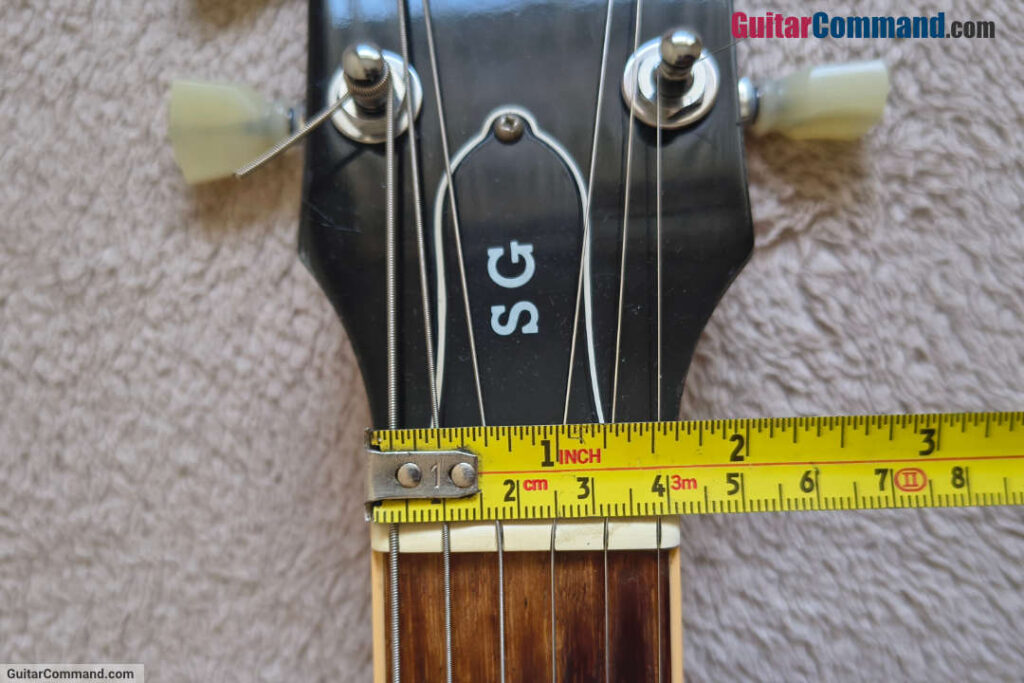
The measurement is taken from the ends of the nut itself. (The distance between the outer strings themselves is called string spacing.)
Nut width determines string spacing near the lower frets, directly affecting how cramped or spacious the guitar feels in your fretting hand.
Neck width can also be measured at the 12th or other frets, allowing for comparison between different guitars (you might see neck width at the nut and at higher frets on a guitar’s specs).
Electric guitar neck widths (measured at the nut) are typically 42mm or 43mm; Fender guitars are typically 42mm; Gibson guitars are typically 43mm, as are most Ibanez RG-style guitars.
The ~1 mm difference between Fender and Gibson is subtle but noticeable: Gibson necks can feel slightly roomier for chords, whereas Fender necks can feel a touch quicker for some players.
However, many modern, “high-performance” guitars have a neck width of 43mm; as with most things, it’s a matter of personal taste rather than a clear-cut decision.
A wider neck provides more room for fingerstyle playing. Acoustic guitars typically have a neck width of 43–45 mm, while the neck width of a classical guitar is typically 50–52 mm.
Fingerboard Radius
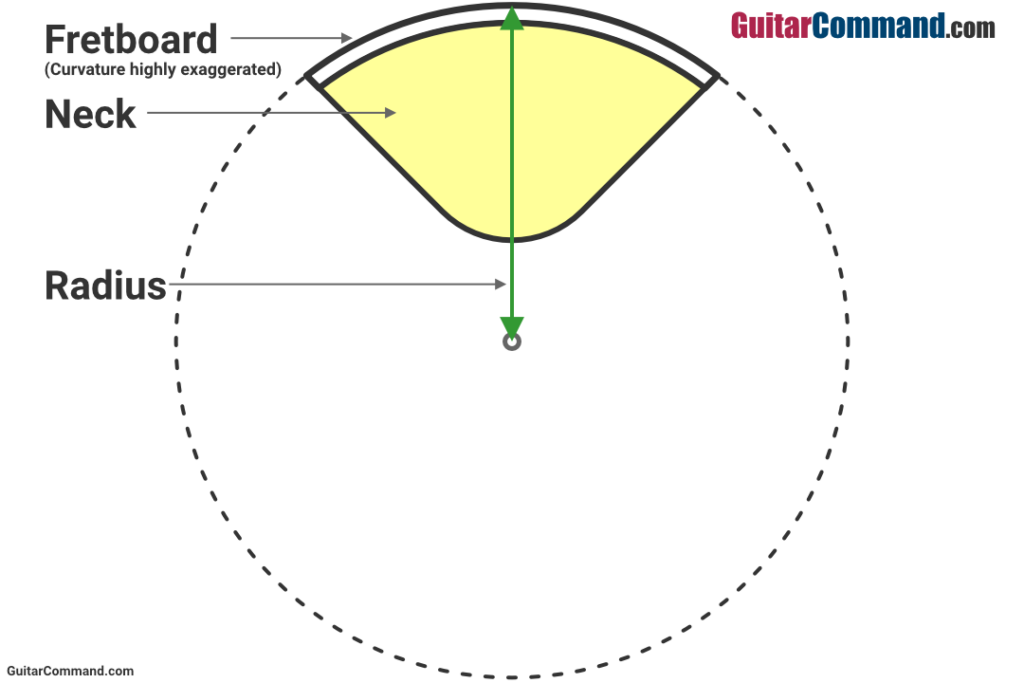
Another aspect of a guitar neck is its radius. Fretboard radius describes the curvature of the fingerboard across its width, measured as the radius of an imaginary circle that matches that curve.
A smaller number (such as 7.25″) means a more rounded fretboard, while a larger number (such as 12″ or 16″) means a flatter surface.
Rounder radiuses can feel more comfortable for chord playing, especially in lower positions, whereas flatter radiuses typically allow lower action and cleaner string bending without fretting out.
Some guitars use a compound radius, which starts more curved near the nut and gradually flattens toward the higher frets to combine comfort and performance.
Traditionally, different electric guitar brands are associated with characteristic fretboard radii: Fender vintage models typically use a 7.25″ radius, while modern Fenders more commonly feature 9.5″ (with some compound 9.5″–14″ options).
Gibson generally favors a 12″ radius as its long-standing standard, while PRS commonly uses a 10″ radius as a middle ground.
More performance-oriented brands like Ibanez and ESP tend to use flatter radii in the 12″–16″ range, with Ibanez often around 15.75″–16″ and ESP frequently landing between 12″ and 16″.
Neck Thickness (Depth)
Guitar neck thickness (or depth) refers to how thick the neck is from the fretboard to the back of the neck, usually measured at the 1st and 12th frets, and it significantly affects comfort, grip, and perceived speed.
Thinner necks—often around 19–20 mm at the 1st fret—tend to feel fast and sleek, as seen on Ibanez “Wizard” profiles (around 17–19 mm at the 1st fret), while medium depths around 20–21 mm are common on modern Fender Stratocasters (roughly 20.8 mm at the 1st fret on an American Professional II).
Chunkier vintage-style necks, such as a 1950s-spec Gibson Les Paul Standard ’50s, can measure closer to 22–23+ mm at the 1st fret, offering a fuller, more substantial grip.
Frets
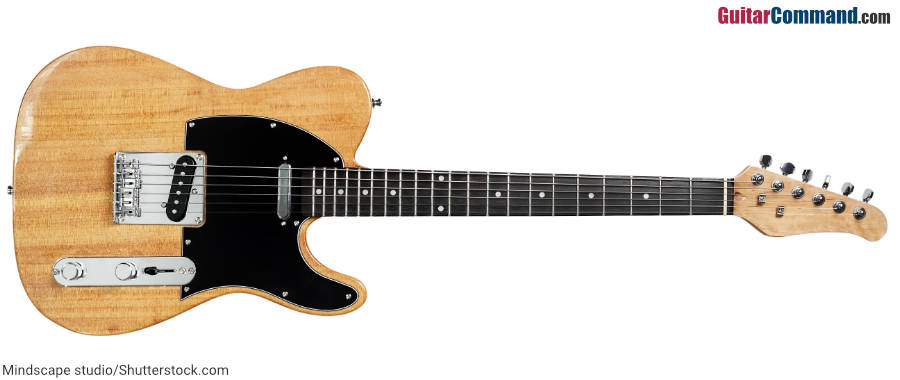
Most electric guitars have either 21, 22, or 24 frets, with 22 frets being the long-standing industry standard.
Vintage-style Fender Stratocasters and Telecasters typically have 21 frets; their modern counterparts 22 frets. Gibson models such as the Les Paul and SG typically have 22 frets.
Performance-oriented guitars such as those made by Ibanez and ESP frequently have 24 frets to provide two full octaves per string for extended solo range.
Acoustic steel-string guitars most commonly have 20 frets (sometimes 19–21 depending on body style), while classical (nylon-string) guitars traditionally have 19 frets, reflecting their focus on lower-position chord work and traditional repertoire rather than high-register lead playing.
Fret Material
Most guitars use nickel-silver fret wire due to its durability, smooth feel, and relative ease of installation. However, stainless steel frets are increasingly common on modern and high-end instruments due to their superior wear resistance and corresponding longevity.
Neck Construction
The three main methods of guitar neck construction are: bolt-on, set neck, and neck-through.
- A bolt-on neck is attached to the body with screws or bolts and a neck plate, making it easier to manufacture, adjust, or replace; this method is commonly associated with Fender-style guitars.
- A set neck is glued into a fitted pocket in the body, creating a seamless joint that many players feel enhances sustain and provides smoother upper-fret access; this is typical of Gibson-style instruments.
- A neck-through (or neck-through-body) design extends the neck wood through the entire length of the body, with body “wings” glued to the sides, offering excellent stability and upper-register access, and is often found on high-performance or modern metal guitars.
Truss Rod
A truss rod is a metal reinforcement bar embedded inside a guitar’s neck that allows you to adjust the neck’s curvature (called relief) to counteract string tension.
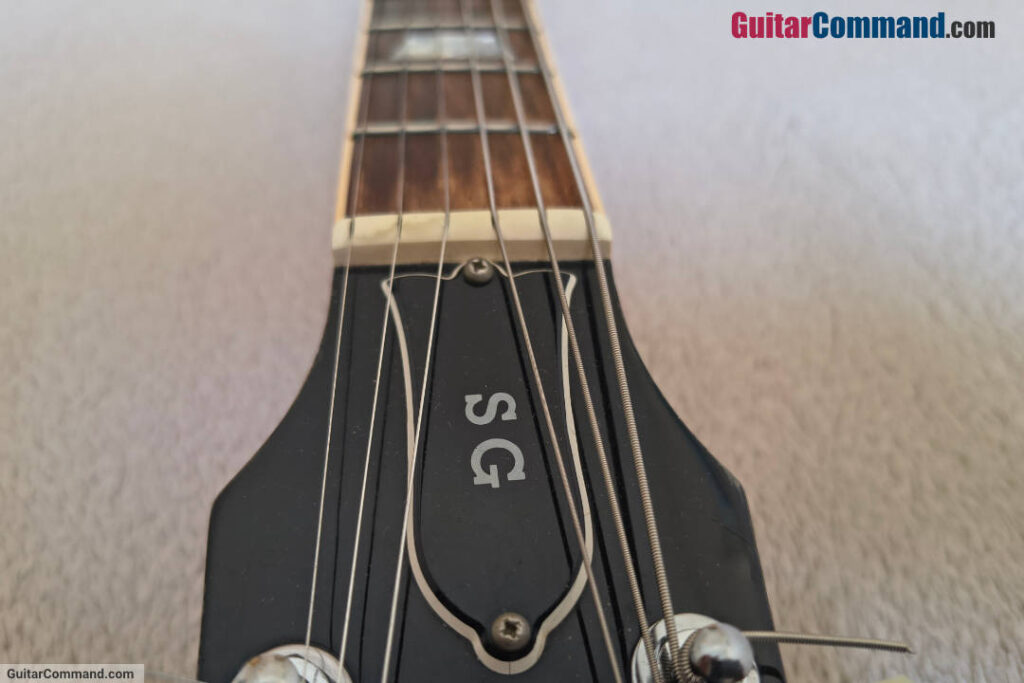
Because strings constantly pull the neck forward, the truss rod provides adjustable counter-tension, helping keep the neck properly aligned and stable.
By tightening or loosening the truss rod, you can correct excessive forward bow (too much relief) or back bow (neck curving backward), which directly affects action height, playability, and fret buzz.
The truss rod is essential for maintaining proper setup and ensuring the guitar plays cleanly and comfortably over time.
The truss rod is usually adjusted at the headstock, although on some vintage guitars, adjustment is carried out at the body side of the neck.
Neck Finish
Guitar neck finishes are most commonly either gloss (typically polyurethane or polyester) or satin, with gloss being historically the most widespread on mass-production instruments due to its durability and protective qualities.
Satin has become increasingly popular on modern and performance-oriented guitars because it feels less sticky and often “faster” under the hand. Gloss finishes feel smooth and glassy but can become tacky with sweaty hands, whereas satin offers lower friction and a more natural feel, though it may wear shiny over time.
Fingerboard Material
Electric guitar fingerboards are most commonly made from rosewood, ebony, or maple, each offering distinct visual and tactile characteristics.
Rosewood is typically medium to dark brown with visible grain patterns and a natural, unfinished matte appearance, contributing to a warm, rounded tonal response and a slightly textured feel under the fingers.
Ebony is darker still—often deep brown to nearly black—with a tight, smooth grain. Less common that rosewood, ebony is typically reserved for higher-end or performance-focused guitars.
Maple, by contrast, is much lighter in color, ranging from pale cream to amber, and is usually finished in gloss or satin, giving it a smooth, sealed surface and a bright, snappy tonal character. It is often seen on Fender and similar instruments.

While tonal differences are subtle compared to pickups and amplification, the visual contrast and playing feel of these materials are immediately noticeable.
Guitar Neck Guide – Conclusion
Individually, factors such as neck shape, width, scale and radius, etc., might only offer subtle differences, but together they can greatly influence the feel and playability of a guitar.
The guitar’s neck is the most important interface between you and the sound you create – hopefully after reading this guide, you’ll better understand the factors that combine to make a guitar neck that is ideal for your playing style!
If you have any questions or comments regarding guitar necks, let us know in the comments section below!
