
What are the best guitar pedals for metal? What pedals do you need to get a good heavy metal sound? On this page, we take a look at the pedals you need to play metal…
Guitar Pedals For Metal: Intro
There are more guitar pedals on the market than ever before, ranging from cheap, mass-produced knock-offs to boutique hand-made pedals from one-man companies run more out of love rather than for profit.
On paper, getting a good metal guitar sound is simple; simply turn the gain on your amp up sufficiently to distort the sound. That’s how it all started after all; early metal players didn’t rely on pedals; they simply bullied their amps into making sounds they weren’t designed to make.
It wasn’t long, however, for the first fuzz, overdrive and distortion pedals to appear. These allowed metal guitarists to refine their overdriven sound.
Not much has changed since the early days; if you’re looking to deliver the crushing, powerful tones of heavy metal, your priority is a good overdriven / distortion sound.
While many modern-day amplifiers feature enough gain on tap for any number of metal sounds, occasionally you’ll need more options, and many metal guitarists use one or more additional distortion, overdrive or fuzz pedals to dirty their sound up.
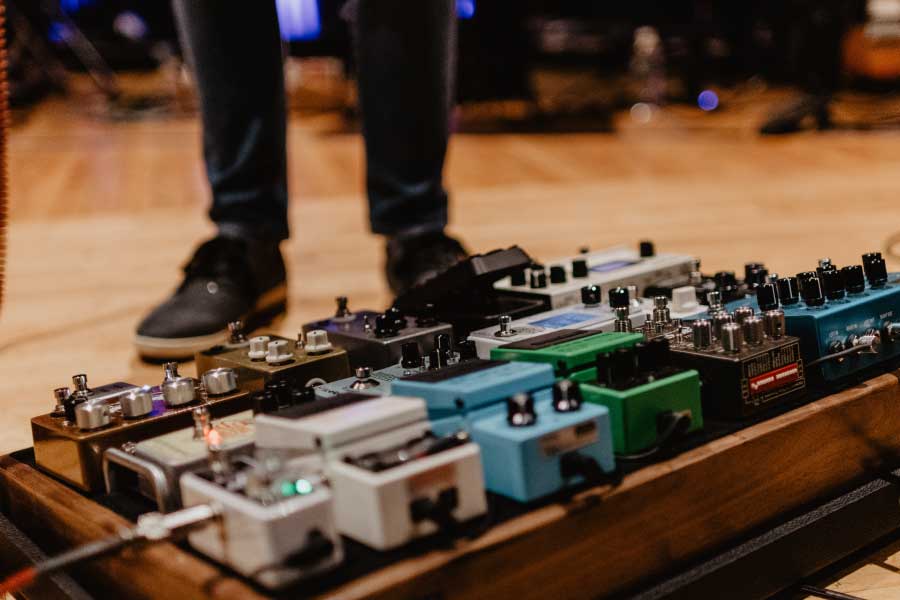
Getting a good metal guitar sound doesn’t (necessarily) stop at distortion; the modern metal guitar player will often further shape his sound with pedals such as delay, chorus, phaser, wah, and graphic EQ.
What Pedals Do I Need for Metal?
Purists would argue that a good metal sound begins and ends with the amp. To an extent, that is true; most modern amps are capable of producing a good metal sound, and that might be all you need, especially at the beginning of your career.
However, the rigs of most metal guitarists often include a combination of one or more of the following pedals:
- Tuner
- Overdrive/distortion/fuzz
- Modulation (chorus, phaser, or flanger)
- Echo (usually delay rather than reverb)
- Filter/EQ
- Wah
Read on to find out more about each type of pedal and how it can help you to achieve the metal tone of your dreams…
Tuner
The first pedal in your pedal chain should be a tuner. Avoid clip-on tuners for metal. You want a tuner that can silence your guitar signal while you adjust tuning in between songs.
Nobody in the audience wants to hear the twanging micro-adjustments of your guitar being tuned.
A good tuner serves two vital purposes. The first is obvious: it allows you to tune your guitar quickly and accurately (even slightly out of tune notes will ruin the sound of your performance).
The second purpose is as an instant mute button. “Silent” tuning is one benefit of this, as is the ability to quickly shut off any unwanted noise from your signal chain.
Boss TU-3
One of the most popular tuner pedals is the Boss TU-3. It’s easy to read, accurate, and very easy to use. It supports drop tuning, making it perfect for extreme metal players. You can also use it to power other pedals!
No products found.
Overdrive & Distortion
So, you want to get a little more push and aggression out of your guitar tone? Metal guitar sounds are typically heavily distorted, so most metal players will use some type of overdrive or distortion to boost their tone.
The list of overdrive and distortion pedals on the market is ever-expanding, and you can spend serious amounts of money on an overdrive pedal. Genuine Klon Centaurs, for example, will sell for over $5000.00.
Boss SD-1
For those of us who don’t want to sell an arm and a leg for a vintage overdrive, however, there are plenty of options. Zakk Wylde, of Ozzy Osbourne and Black Label Society fame, for example, used a Boss SD-1 to push his Marshall amp into feral saturated glory for the No More Tears album.
No products found.
B0013NDBS6
Ibanez Tube Screamer
The Ibanez Tube Screamer is another classic overdrive pedal. Metallica’s Kirk Hammet has famously used a Tube Screamer as his main boost for guitar solos for decades now. The Tube Screamer sounds best, as the name implies, when played in front of a decent tube amplifier.
No products found.
Proco Rat
When you want a more aggressive, snarling tone, you might turn to the increased gain levels of a classic distortion pedal. For decades now, the Proco Rat has been the definitive metal distortion pedal. Its “filter” control means you can use a Rat for your tight, chugging rhythm sounds as well as searing leads.
Notable Rat users include Morbid Angel’s Trey Azagthoth and avant-garde guitarist Buckethead.
No products found.
Boss Metal Zone
The Boss Metal Zone is probably the most controversial pedal on the planet. Its gain range is far too wide to be practical, and its two-knob EQ is far from intuitive.
When used right, however, the Metal Zone is one of the most powerful, articulate distortion pedals you can find.
Its lower price point implies that this is a beginner pedal, but we’d recommend embarking on your Metal Zone journey once you know how to tweak a pedal and amp to your personal preferences.
The pedal sounds best in the amplifier’s effects loop – effectively functioning as a preamp – rather than before the amplifier, which is where you’d put most distortion pedals.
No products found.
Boss DS-2
For a more readily tameable alternative to Boss’ Metal Zone, you might want to consider the Boss DS-2.
Used by players as varied as Kurt Cobain and John Frusciante, this classic distortion pedal is one of the most useable metal pedals available.
With standard distortion controls, plus switchable modes that instantly change the character of the pedal, the DS-2 is capable of delivering a wide variety of metal tones.
No products found.
Fuzz
While fuzz isn’t a commonly used pedal for most metal guitarists, it’s almost a given in doom, stoner, and sludge metal subgenres.
EHX Big Muff
Setting the standard for modern fuzz enthusiasts is the EHX Big Muff, with a sensitive EQ and all the saturated, harmonically rich fuzz tone you could want.
No products found.
Jimi Hendrix Fuzz Face
If your taste in fuzz leans more to the psychedelic end of the scale, the Jimi Hendrix Fuzz Face has a distinctive look and timeless tone.
No products found.
Chorus, Phaser, and Flanger
Modulation effects are really a matter of personal choice. Some players can’t leave home without their phaser, and others eschew these effects entirely.
Most metal players use chorus either to thicken up their rhythm sound in a single-guitar ensemble or to add some shimmer to their clean tone when required.
Motley Crue’s Mick Mars and Black Label Society’s Zakk Wylde both used chorus pedals for their rhythm tone to great effect. As an example of how chorus can be used for a clean metal tone, look no further than the bridge section of Metallica’s “Master of Puppets”.
For either sound, it’s hard to go past the warm, authentically 80s tone of the MXR Analog Chorus or Boss’s classic CE-2 chorus.
No products found.
No products found.
Phaser and flanger are similar “whooshing” effects. We’ll turn to Van Halen for prime examples of both. For phaser, listen to “Eruption”. For flanger, listen to the intro to “Unchained”.
As you’d expect, considering that Edward Van Halen has probably had more influence on metal tone than any other guitar player, there are EVH-spec pedals for both phaser and flanger.
The MXR EVH Phase 90 has a useful “script” switch that allows you to indulge both modern and vintage flavored phasing, and the MXR EVH Flanger has plenty of controls so you can cover all flange tones from the “airplane taking off” sound of “Unchained” to a subtler motion for your long, legato lead lines.
No products found.
No products found.
Echo (Delay & Reverb)
As a general rule, most metal players avoid using too much reverb. Reverb can muddy your guitar tone, particularly when you use a lot of distortion in a band setting. That’s not to say metal guitarists avoid it entirely. Rather, it’s used quite sparingly, and you’ll hear it less often in more technically-demanding metal subgenres like thrash and speed metal.
Delay, on the other hand, tends to be most metal players’ echo effect of choice. It can be used for a gentle slapback (once more, we turn to Van Halen and “Ain’t Talkin’ Bout Love”), or to add flavor and color to your guitar solos.
The Boss Digital Delay is one of the most versatile and useful delay pedals you can get.
No products found.
If you want something with more options (including reverb, if that’s your taste), Keeley’s Caverns Delay is probably the pedal for you. It’s got plenty of tonal versatility so you can leave it on your pedalboard between metal and ambient gigs.
No products found.
TC Electronic’s Flashback is another great delay pedal with plenty of presets for you to choose from, and true bypass so your tone won’t be affected if you don’t want it to.
No products found.
Filter/EQ
An often underrated guitar pedal across all genres is the EQ. Sure, your amp has an EQ, but what if you could pick out particular frequencies in your guitar signal before hitting the amplifier? The EQ allows you to eliminate feedback where necessary, gives you a chance to highlight certain frequencies for solos (hello, midrange boost), or even to scoop your mids for classic thrash chugging tone.
The Boss GE-7 is most popular among metal players for its ease of use and boost/cut control. You can add or cut gain when the pedal is on simply by setting the “level” fader to your liking. Great for a clean boost when it’s solo time, or for carving out a thick, articulate rhythm tone.
No products found.
Wah
The wah pedal does exactly what it sounds like: it makes your guitar go “wah”. It was meant to mimic a similar effect used by jazz trumpeters playing with a “mute”, but wound up being most associated with electric guitar.
It’s a cool effect most commonly associated with compressed funk tones, but it’s been used in metal for decades now.
Some notable metal players who love using a wah pedal include Dimebag Darrell, Zakk Wylde, Kirk Hammett, Eddie Van Halen, and Slash. Each have their own signature model wah, based on the classic Dunlop Cry Baby.
If you want something that can add personality, power, and punch to your solos, the Cry Baby may be the pedal for you. Learning to use it takes some practise, but once you can nail the vocal tones of “Voodoo Chile”, it will all be worthwhile.
No products found.
Guitar Pedals For Metal – Conclusion
On this page we’ve looked at a variety of pedals used by heavy metal guitarists of all genres. Although your amp will probably be capable of providing a decent basic metal sound, the extra flexibility offered by a small, well-chosen selection of guitar pedals can really help you get your dream metal guitar tone.
How do you get your metal guitar tone? What is in your metal pedal board? Let us know in the comments section below!
